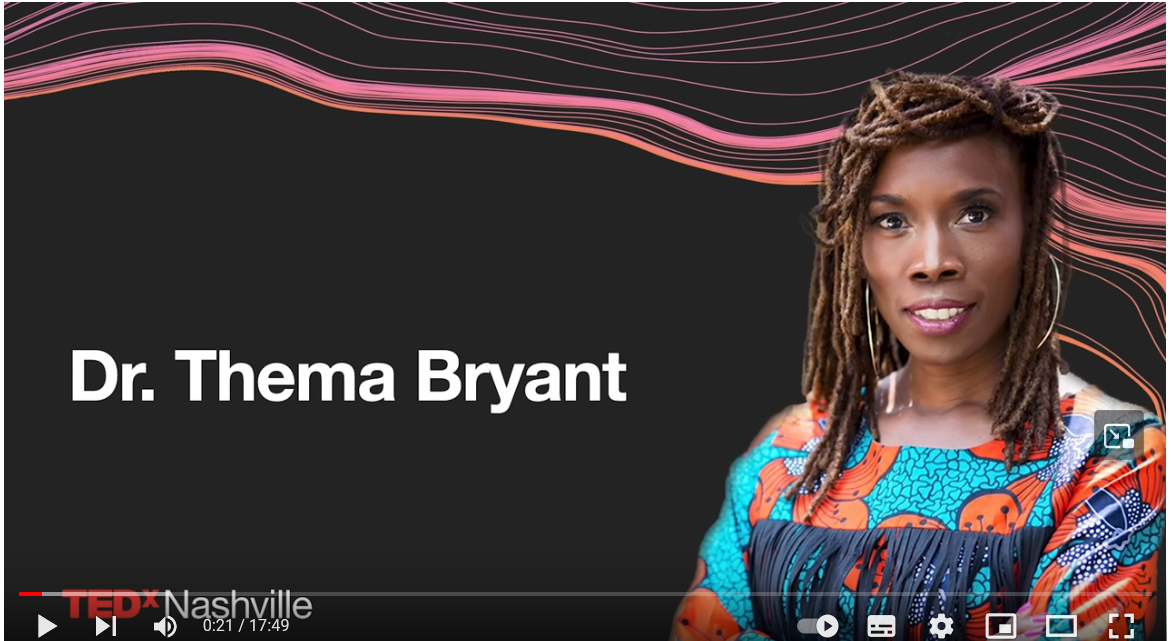
In this TED talk Dr. Thema Bryant explains what she sees as the difference between colonized (bad) and decolonized (good) psychotherapy. This short video demonstrates very clearly what the hundreds of posts (articles, videos, insider accounts) on the CTA website have been drawing attention to: the disastrous antitherapeutic political hijacking of the therapy professions.

In her talk, Dr Thema Bryant is trying to justify the regressive reductive turn in current psychology: one that seeks to replace a focus on the individual with foregrounding the collective and contextual (see Cynical Therapies which argues for continuing to integrate the individual with the collective in a balanced and effective way). All the characteristics of cult indoctrination are in evidence here (Bryant is an ordained chiurch minister). Note the use of rhetorical devices such as repeated emotionally powerful phrases: “Justice is healing; justice is healing”. Note the simplistic binaries of identity politics; good/bad, right/wrong, us/them etc. Note the call to political action: the goal of therapy is to empower people to work towards societal change.

Finally, observe the risible stereotypes at work. A vignette of a black family is presented who appear to have no agency whatsoever. First, the family is subjected to a colonized psychology intervention (bad) in the form of an instrumental transactional intake session. Then the whole family encounters a decolonized psychologist (good) using a mixture of dance, movement, song and other non-Western interventions. The family is magically liberated and transformed through understanding that all their ailments have come into being through societal oppression.

We could ignore this video save for one important fact: Dr. Thema Bryant is the 2023 president of the American Psychological Association

9 responses to “The President of APA Says We Need a Decolonized Psychology”

  1. What does “decolonized” even mean–and what are the practical benefits (and implementation strategies) of it? I’ve read a bit of this in graduate school and still continue to feel puzzled about it all.

  2. […] into a Critical Social Justice-driven view of therapy. They are primed as unwitting agents for a deconstruction project, one that is already underway in the […]

  3. […] of this postmodern political belief system are explicit about its totalising aims, in particular, the decolonisation of psychology. Using rhetorical strategies has allowed this political approach to sidestep any public scrutiny […]

  4. […] the next generation of professional psychologists and their patients in the perversion of critical social justice ideology. This imprudent binary logic of pitting identities and racial groups against one another only […]

  5. […] the next generation of professional psychologists and their patients in a deeply-flawed critical social justice ideology. The imprudent binary logic of pitting identities and racial groups against one another only […]

  6. […] the next generation of professional psychologists and their patients in a deeply-flawed critical social justice ideology. The imprudent binary logic of pitting identities and racial groups against one another only […]

  7. […] promote the necessary move towards decolonisation in the therapy professions (presumably they share Thema Bryant’s vision?). They also seem to believe the new EF will advance relational ethics (at CTA we would argue that […]

  8. […] with their clients. Descriptions by clinicians who espouse a ‘decolonised’ psychology, such as Thema Bryant (President of APA 2023-2024), would indicate that it is an emergent type of cultural practice. So […]

  9. […] sounds as if a decolonial approach could be anything the therapist wants it to be (for example, see Thema Bryant’s Ted talk). Arna Mitchell, a NZ clinical psychologist of Maori heritage, warns of the psychological damage […]

Leave a Reply to What’s in a Name? Not ‘Activist Therapists’ but ‘Identity Practitioners’ – Critical Therapy AntidoteCancel reply

Trending

Discover more from Critical Therapy Antidote

Subscribe now to keep reading and get access to the full archive.

Continue reading