

Dr Carole Sherwood (retired clinical psychologist and CTA co-director) and her colleague, Andrew MacLeod (Emeritus Professor of Clinical Psychology) have just released a report on the results of a survey conducted in collaboration with The Free Speech Union. They conducted an online survey of 255 people who had experienced cancellation combining questions written for the study with standardised measures of depression, anxiety, stress and post-traumatic stress. To the authors’ knowledge it is the first survey to examine the effects of cancellation on members of the public with a specific focus on their mental health. The release has been accompanied by a piece by Lord Young of Acton, Director of The Free Speech Union, published in the Daily Mail.
Below is the executive summary from this important report. We encourage everyone to read the full report here.
Executive Summary
We conducted an online survey between June 2025 and April 2026, to investigate people’s experience of being cancelled and its relationship to mental health.
The survey contained a range of questions developed specifically for this study, as well as standardised measures of depression, anxiety, stress and post-traumatic stress.
Respondents were invited to describe their experiences of cancellation. 255 respondents who had experienced cancellation were recruited through The Free Speech Union and several other organisations. The sample was
predominantly highly educated, middle aged to older men and women who mostly described themselves as heterosexual, white British, and were more right-than-left leaning. Employment, marital status, religion and the presence of dependents varied across the sample.
Key findings:
- Cancellation took place in several different settings. The workplace was the most common, followed by friendship groups and at university. Other settings included the charity sector, volunteering, social media, social clubs, political parties, the arts, professional membership bodies and regulators [see Appendix 3 for full list]. 20% of the sample said their cancellation spanned more than one context.
- Views on gender identity and, to a lesser extent, race, were common reasons for cancellation but there was a wide variety of other reasons, including political views and views on Covid-19, Islam, immigration, Brexit, and support for Israel.
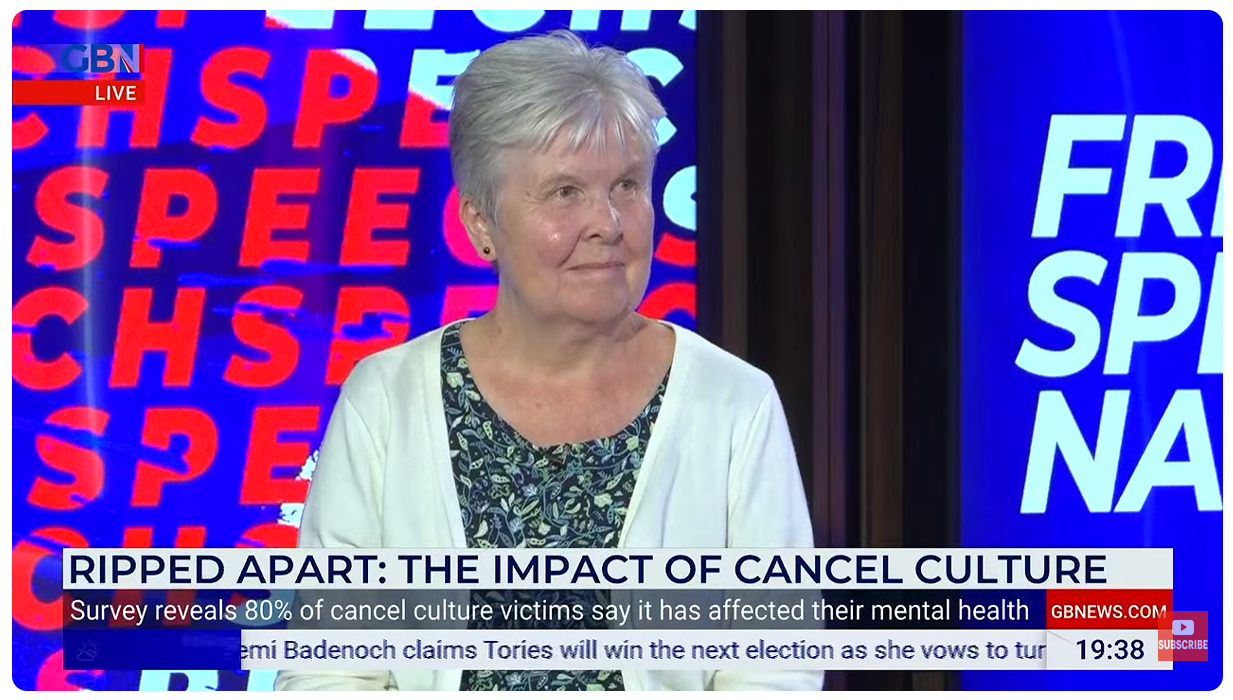
- Respondents reported that cancellation had marked negative effects on their lives, with over 80% saying that their everyday lives had been affected. Just over half the sample said that their career had been affected, with 27% reporting they had lost their livelihood.
- In terms of support, a majority of the sample said they could rely on family. This number was lower for friends and markedly lower for colleagues.
- Respondents described striking effects on mental health. Over 80% said their mental health had been affected. One third said they had sought help from a mental health professional and 27% reported they had taken medication as a result of the cancellation.
- Reported effects on mental health were supported by standardised measures of psychological distress. These showed significantly elevated levels of depression, anxiety and stress compared to general population scores. Over one third of the sample also displayed traumatic responses to their cancellation indicative of Post-Traumatic Stress Disorder.
- A sub-group of about 20% of the sample scored in the most severe depression category (compared to the 3% reported in a general population sample). This sub-group, who also had very high rates of traumatic response, were more likely to have had careers affected or to have lost their livelihoods and experienced damage to relationships and less support from family members.
- We conclude that cancellation is a destructive force that harms psychological health, disrupts the workplace and other environments and presents a risk to wider society through the breakdown of social bonds and trust.


Leave a Reply